Lyra Sieradzka
From now on, words must have the same function as bullets.
L. Lakhdar & M. Khayati, Waiting For The Massacre
Introduction
Capital loves names. A name’s an alibi. When an event profanes the basic moralities by which the system purports to exist, it is always attached to a name. Someone who did the deed. It is the purest distillation of the bourgeois conception of history. Great and terrible deeds are not performed by regular people, as enabled by a definite social system. They are the feats of some titanic personage. We witness in all affairs of states and nations and human history the works of those so far above us they may as well take the shape of God.
More important is the name’s function in practice. Take a few names of particular infamy: Hitler, Himmler, Goering, Goebbels, and so on. These are names we know well. They are terrible names, responsible for terrible things, and all of them got their comeuppance in the end. On this, we are all agreed.
But the bourgeois histories, in most cases, end there. The good guys had won, the bad guys were punished, all’s well that ends well. We, by contrast, are concerned with a different history. It’s not even the history some of us come to later learn: that many Nazis became powerful postwar figures, exonerated, lavishly dressed up in positions of power (Kiesenger, West Germany’s third Chancellor, is a notable example). This is a less-known crime, a black mark, but it is not the last indictment to make.
Our history is not the history of names, but of classes. It is of the pact the Nazis made with the German bourgeoisie: you will obey us, you will give us what we need. Do this, and our new German state will make you prosperous beyond imagination.
The German bourgeoisie accepted, of course. The Nazis went about making good on their promise. For the German bourgeoisie, the rewards were immense. Those who served the Reich received functional monopolies on whole industries. German capital grew fat off the spoils. And in turn, they made good on their half of the bargain. Mercedez-Bens and BMW produced for the Wehrmacht and Luftwaffe. Hugo Boss designed those sleek leather outfits the Schutzstaffel wore. Krupp gave steel and munitions to the war effort. And IG Farben made Zyklon B for the death camps.
By the time the writing was on the wall, and it became clear the teetering house of cards of nazi hegemony—military failures, an ever-straining and farcical economy, and completely untenable territorial ambitions—would fall as swiftly as it had risen, the German bourgeoisie didn’t stop. They kept on going, they kept on producing guns and aircraft engines and uniforms and poison gas. The bourgeoisie are most often fickle and faithless bastards, but German capital’s loyalty to the nazi state persisted well past its sell-by date. It seems strange at first. Then we notice that there is nothing left to be loyal to but themselves. There is no meaningful, operable distinction between ‘nazi’ and ‘german bourgeois’. They are less in bed together and now fully entwined, decorated bourgeois party members decorating other bourgeois party members. It has been this way for a while. German business does not support German fascism; German business is German fascism.
Through the ancient, venerated institution that is war, and especially bourgeois war, which is its most absolute and total iteration, the German bourgeoisie had been richly rewarded for spilling an incalculable quantity of proletarian blood. This specifically, however, is not a crime. We are well aware of the justice dispensed in this regard, which is none at all. There was the typical mealy-mouthed condemnations, the token attempt at ‘denazification’, a small handful were killed at Nuremburg, but in the end the vast body of the German bourgeoisie got off scot free. Of those listed companies only IG Farben got the axe. Well, what can be said when the trials were orchestrated by capitalists? The bourgeoisie judged itself, and behold, it was found innocent.
These people made Nazi rule a reality, they were the engine of its conquests, the architects and beneficiaries of its crimes, for which they were rewarded with blood and treasure. Without them, Hitler and his people would’ve had nothing. Yet after being so thoroughly encased in the skin of Nazism, they slid out of it the moment the ash settled.
Hitler was a fall guy. Hitler and his circle get the sins of the bourgeoisie loaded all upon them, iconographed as the arch-villains of the era, folded into the final cataclysmic birth of a deliberately typecast modern Germany, pleasant, rational, penitent, and safely beneath the rule of the same bourgeoisie. Nothing changes. The crimes are exported elsewhere, the culprits get off with a slap on the wrist, and we are left with poetry about the crimes of Hitlers and Little Eichmanns.
We receive no justice and we’ve learned to expect none. As with all things it is seized ourselves. And so we turn the page, to contemporary times, where yet again we’re faced with another great massacre, and as always, a fresh bunch of names.
I
The Israeli bourgeoisie was born complicit. Launched into the world in apocalyptic carnage, slaughtering and displacing an entire people, Israel never tired of reminding its subjugants of what could well happen again if they didn’t play nice. Pundits would openly discuss the utility of a second Nakba (speaking in Hebrew, of course, in English it’s always about a moral army, democracy, etc.), laugh and smile about it. The bourgeoisie worldwide would whistle like nothing was happening.
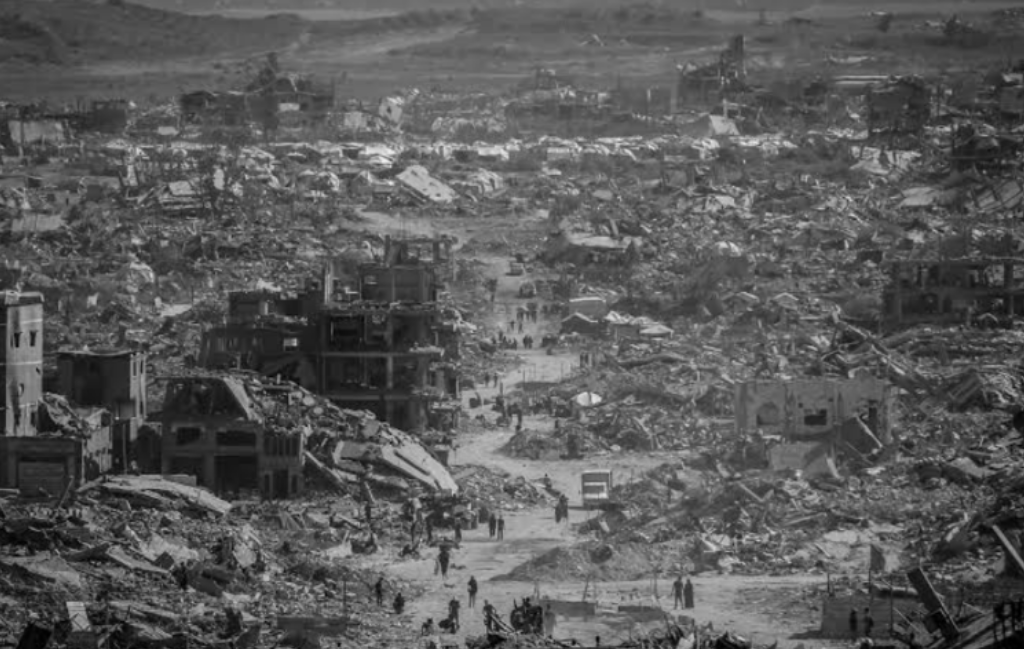
Following the attacks on Oct 7th 2023, Israel finally made good on this promise. Since then we have for three years watched as a people are systemically murdered and displaced and crushed beneath rubble. Naturally, a new set of names emerge (such as Netanyahu and Ben-Gvir, suitably villainous foils for what is ultimately the work of a bourgeois settler project). We have witnessed the bravery and resolve of the Palestinians, who some self-appointed socialists have gone so far to credit for the present state of ‘socialist agitation’.
It is hard to see in such an assertion anything but a damnable self-condemnation for today’s left. A people are being wiped out and all today’s socialists can do for them is be glorified cheerleaders, elect Zohran Mamdani to oversee New York’s police brutality instead of Andrew Cuomo, get Abdul el-Sayeed on side just in time for him to explicitly state he’s nakedly pro-capitalist, swell the rank-and-file of the DSA (an organisation that has never achieved anything of note for class struggle in the history of its existence, but will surely do so now they have Hasan Piker), all while failing to actually bring an end to the genocide bloodily invoked as the herald of a new socialist wave.
Almost nobody discusses strategy as communists anymore. So let us try.
Palestine’s history is a history of primarily national struggle. Inhabitants of the region were, historically, in possession of a broad sense of common identity, but the institution of modern Palestinian nationhood emerged out of resistance. This is invoked by Zionists and their lickspittles as means to decry such a nation as fundamentally fake. The only response is to laugh. All nations are ‘fake’ in the sense they are abstractions, not least Israel, and the most surefire way to make an identity ironclad is to give it real stakes—like, say, a protracted war of survival. And look what you’re doing to the Palestinians!
But the bourgeoisie have never been content to reap what they sow. This is why genocide is their favoured weapon in these circumstances, the instrument of annihilation when the problem grows too large to ignore. It is the steepest ultimatum, carefully considered beforehand, and not so much unleashed as applied mechanically. There is the genocide carried out in red hot feats of rage, seen in the poisonous words of Netanyahu, Smotrich, Ben-Gvir—this is an important part of the alibi, that the slaughter was entirely the work of irrational and malevolent actors, and did not have a further purpose.
The true intent of such a genocide exists in its mechanical impassion. The problem is identified, excised, and paved over. It is industrial. It is calculated beforehand and carried out according to a scheduled plan. Gaza is to be, as Israeli pundits remind us (now in English), ‘turned into a parking lot’, now they’ve tired of ‘cutting the grass’. The rote brutality is intensified to a searing heat for the purposes of cauterisation, and then it is gone. One day they start thinking about the happy Jewish families in the resettled Gaza strip, the smiling children playing there, and won’t spare more than a thought for the bones beneath.
This is not the region’s absolute fate. It is a disservice to sign a people’s death warrant before its due. But it is the fate it is poised to receive if something does not change.
This change comes from struggle. But as stated, Palestine’s struggle is national. We will investigate what national struggle entails, how struggle emerges, and most importantly, where class struggle is realised.
Class struggle remains the forgotten but crucial key. The alibi is infinitely contingent, extended from the practice of individuals to the practice of a nation. If it ends in Israel, it may come closer to ending for good. This is a lie. The great empires of the world will always be hungrier for labour and resources, and this will continue to include the death of innocents, and almost certainly the prescription of further genocide.
Capital and all its many supporters require every layer of this alibi to remain intact, because without it the crimes are laid bare as the feat of a class. It is with the wealth of capital and all the great empires that the weaponry and logistics of genocide are carried out. America, Europe, China, and Russia are all as complicit as each other beneath this single bond. Israel is simply a trade partner. If the massacre is successfully ignored for long enough, they can find the fall guys and be done with it, and get on to ignoring the next one. The culprit escapes justice again.
The only judge that will ever try these criminals is the victorious proletariat, standing at history’s pulpit. Such is the one path to avenge the myriad slaughtered peoples of the ages.
It is all very well to say this. We are then charged, as communists, to provide our prescribed course of action. We do not have an answer. We are impotent to do anything. We are sloganeers in a world where our slogans mean nothing. So a national struggle Palestine remains.
II
Struggle is like flowing water. It follows the course most natural. People don’t toss a struggle down in its tensest moments to pick another one up on the premise of hope alone. People struggle as they have to. But struggle is not a predelineated course of action, with boundaries, beginning, and end assigned.
We have already seen how the national struggle of Palestine has developed into an affair with a scope larger than the boundaries of the Palestinian nation. Israel’s undue leeway has been extrapolated. More than ever people see the system of lies, hypocrisy, and blood that undergirds world imperialism. Nevertheless, the principal demand is confined to Palestine. This, however, is not even where the issue primarily lies. Before anything else, what lies in the way those who call themselves socialists have elected to organise in response. The socialist answer has been activism.
By activism we define the activity of those who may well be proletarians but do not wield the instrumentality of their labour in their political activity. They operate discrete from class organisation.
There is no better way to blunt your bayonets than with activism. Protests are reduced from calculated shows of force to rote voluntarism. Sabotage and raids become sporadic, and all offensives are based on moral commitment rather than the less virtuous but much more effective sense of personal stake. Morale slumps, the protests dwindle, the fires dim. Flashpoints reignite tensions, only for them to ebb again. The police gently disperse rowdier demonstrations. Meanwhile, safely in government no matter the party, the bourgeoisie tend to the matter of restricting public order, politely rendering ordnances against dissent.
The missing ingredient is labour. Labour is the sharpened point that’d make this stick a spear, and give all these brave and committed people a fighting chance and a consistent base of support. Sabotage disrupts imperialist logistics, strike action cripples it. And in doing so you show to workers the reality that there is now power in their hands, which they can use. You can melt all the apathy by demonstrating the real avenue to not just improve one’s life, but keep winning, keep advancing, pushing a living front against bosses everyone’s learned to loathe.
We start with a struggle where race and nation have ostensibly seized the place of class. Over the course of this struggle we illuminate what we have been fighting against all along: the bourgeoisie, the bane of all peoples, that infernal class that now takes shape in its entirety, and which once again is faced with the flame of revolt. And should this happen, we have also clearly delineated a shared interest, a common bind, that transcends nations, and begins to show the embers of a unified political subject. It is then possible to say to Palestinians: yes, we can free Palestine. But we can also free the world.
This only happens when it happens, though. It’s not something we can project into the future. So for now, Palestinians remain in a state of national struggle. Ours is a steep order. It sounds far-fetched. Such is communism, which appears impossible, just like all those other impossible things, like liberal democracy and the end of absolutist monarchy.
What we get is a direction. A definite objective, a definite place to cultivate our base of power. It gives us a definite premise for struggle. It is clear that the first objective is to organise the workplace. This is not a neutral terrain, and the same grounds of race and gender and sectionality will necessarily apply. There are challenges that require further thinking. But it seems self-evident that the party of the working class finds its first port of call with the working class.
So it’s somewhat confusing that so many communists instead seem to go anywhere but the workplace—protests, book readings, meetings, et cetera. All well and good, important, but the notable exception confounds me. I know communists who organise strikes at workplaces exist. I have met them. They have flesh and blood. I can see them with my eyes, I can hear them with my ears. They assuredly exist. But they are a slim minority of a slim minority. When I raise the option that we start from a real class organ, I get raised eyebrows. “Why would we do that?”
The problem may be that a lot of people who call themselves communists aren’t communists, that the amount of people fighting for communism is vanishingly slim, and we’re actually overrun by fairweather comrades and cosplayers who don’t really care for the task at hand. This is fine. We’re used to this. We say to all the deniers, falsifiers, and modernisers: you, too, will become Communists.
III
We have summarised why we contend the programme of national liberation—that is, the establishment of a new state, free and independent of any encroaching or oppressing empire—does not advance class struggle. What we also advance is that it is not actually proven possible. Subjugated nations which toss off their shackles, as in Vietnam or Burkina Faso, are resubjugated; either in a single strike in the case of the latter, or procedurally in the case of the former. Some, alike China, develop into a state of imperialist supremacy themselves.
We must also soberly assess is this is our failing, as Communists. Capital will not stop brutalising nations and peoples and we have failed to heed the call to provide a working alternative to national struggle. This is an important stance to take. Not because we need grovel in penance for our crimes of inaction—we are not relevant enough for anyone to care—but because it allows us to orient ourselves in a way that addresses the world as it exists rather than trying to prescribe it in a way which excuses our failings.
We start that, from the perspective of the Palestinian proletarian, they are selected for extermination on the basis of their race. But this is ultimately class warfare against them; on the scale of history, it is the extermination of a proletarian to serve the purposes of a bourgeois project. We do not erase or occlude the racialisation through this realisation. It is fundamentally true that the project of settlerism has all but precluded the formalisation of an Israeli proletariat which acts independently and as a political subject. The same is true of Palestine (in the inverse, as victims of settlerism), but unlike in Israel there exists greater possibility for transformative struggle. This is a property of all struggles where proletarians are massacred at the hands of the bourgeoisie.
A common pitfall on the ‘Communist left’ is the apparent belief that ‘no war but class war’ advocates an immediate halt to national struggles. This is untrue. We hold such a slogan to mean what it really means: that “the history of all hitherto existing society is the history of class struggles.” There is no war but class war. The struggle in Palestine is a struggle against the might of bourgeois imperialism, and it retains its national character only as long as that fact remains unoccluded.
Proletarian self-activity only comes about with staying power in times of crisis. We predict nothing with certainty, only offer examples of what could be. Marxism is not a universal theory for all existence, it is the science of revolution and with it we postulate only one contention: the end of the era of genocide and slaughter, of war and exploitation, of rifles and atom bombs, is brought about with the day of the victorious proletariat.
Again, it is all very well to say this. But we have to prove it, also. We are in luck! The present crisis only grows more apocalyptic in scope, pouring in from every horizon a tumultuous reassembling of the world order, shaking to the core empires old and mighty and bringing discontent to every heart. There is much to do and much to work with. For while sometimes history is content to a seemingly endless inaction, there come times when all it needs is a gentle push.
And from the way things are going, I suspect it’ll get much more than that. It is time to get to work.
In that case we do not confront the world in a doctrinaire way with a new principle: Here is the truth, kneel down before it! We develop new principles for the world out of the world’s own principles. We do not say to the world: Cease your struggles, they are foolish; we will give you the true slogan of struggle. We merely show the world what it is really fighting for, and consciousness is something that it has to acquire, even if it does not want to.
Marx, 1843